

Custom Nanomaterial Service | Injectable Hydrogel in *Advanced Functional Materials* Regulates Sphingolipid Metabolism to Inhibit Breast Tumor Recurrence

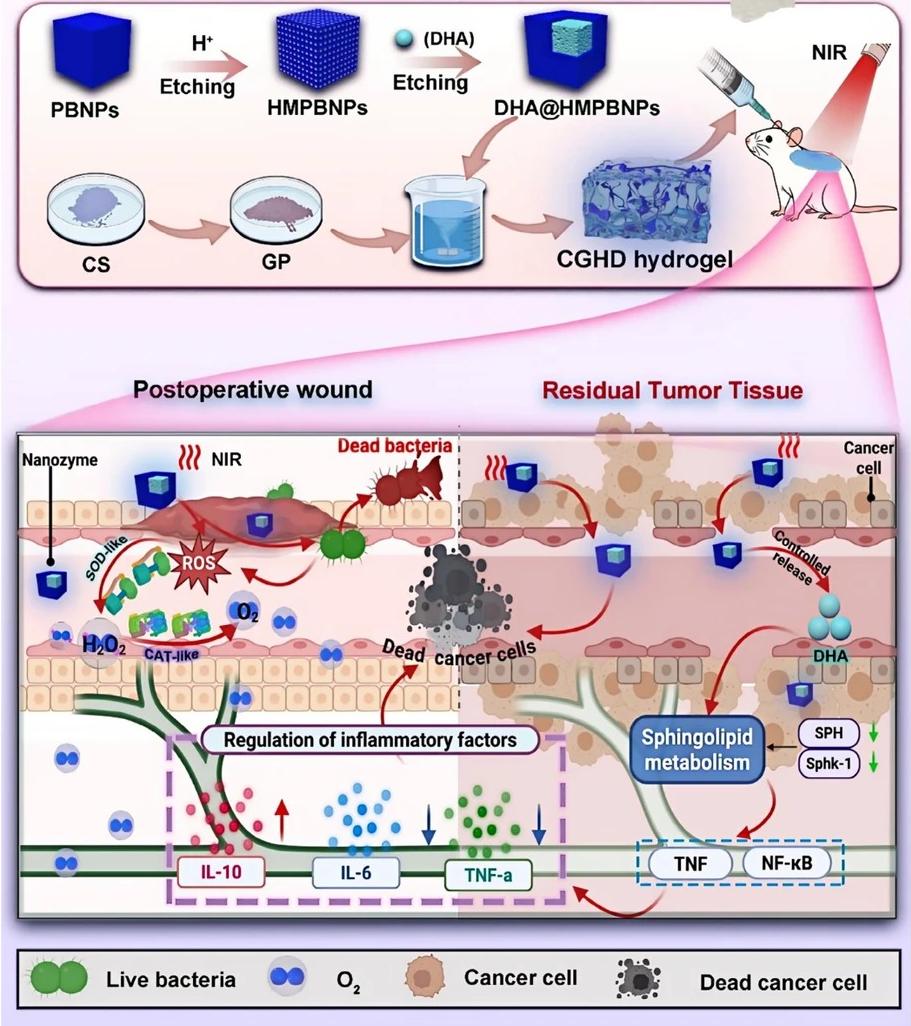 (1) Journal Source: Advanced Functional Materials
(2) Title: Reprogramming Sphingolipid Metabolic and Redox Homeostasis with an Injectable Botanicals/Nanozymes Hydrogel for Inhibiting Postoperative Recurrence and Metastasis in Breast Cancer
(3) Research Highlights: In this work, an injectable CGHD composite hydrogel integrating Prussian blue-based nanozymes and plant-derived dihydroartemisinin was designed. With near-infrared light irradiation intervention, the regulatory effect of this system on the postoperative breast tumor microenvironment was investigated, and the intrinsic mechanism underlying the inhibition of tumor recurrence and metastasis was analyzed from the perspective of sphingolipid metabolism and redox homeostasis.
(4) Innovations: ① Construction of a thermosensitive injectable hydrogel integrating nanozymes and natural active molecules; ② Taking sphingolipid metabolic reprogramming as an intervention target to break the oxidative stress-inflammation feedback loop; ③ Near-infrared responsiveness to achieve the synergistic effect of photothermal therapy, enzyme catalysis and drug action; ④ Elucidation of the regulatory mechanisms of sphingolipid metabolism and the NF‑κB/TNF signaling pathway via multi-omics approaches.
(5) Material Development (1) Materials: Thermosensitive chitosan‑β‑glycerophosphate matrix; hollow mesoporous Prussian blue nanozymes (HMPBNPs); natural active molecule dihydroartemisinin (DHA), which were combined to fabricate the CGHD hydrogel. (2) Functions: It features injectability, in-situ sol-gel transition and tissue adhesion; it exhibits SOD/CAT-like enzyme activity to scavenge reactive oxygen species; it produces near-infrared-responsive photothermal effect and enables controlled release of DHA; it possesses antibacterial, anti-inflammatory, sphingolipid metabolism-regulating and residual tumor cell-killing capacities, and supports wound tissue repair simultaneously.
(6) Extended Perspectives: The catalytic performance of nanozymes can be further optimized, and other sphingolipid-modulating active molecules can be incorporated; the differential effects of different administration routes on sphingolipid metabolic pathways can be explored; the application potential of this hydrogel in other postoperative models of inflammation-associated tumors can also be explored.
We provide full-process services for custom material design, including innovative scheme design, fabrication, characterization, and in vitro & in vivo validation (cell and animal studies). Our postdoctoral team with multiple high-impact Q1 publications can tackle your challenging research demands. Our scope covers hydrogels, drug delivery systems, nanomaterials, polymers, liposomes, microneedles and more. We support project design, NSFC proposal writing, and high-quality SCI manuscripts for journals such as AFM, AM and other Q1/Q2 journals. Enquiries are welcome👇
17768014569 (Dr.Gao)
17761925168 (Dr. Zhang)
18013729810 (Dr. Yang)
18915694570
Previous: One Orthopedic Idea a
Next: Nanomaterial Customiza