

Ophthalmology field
(1) Abstract:
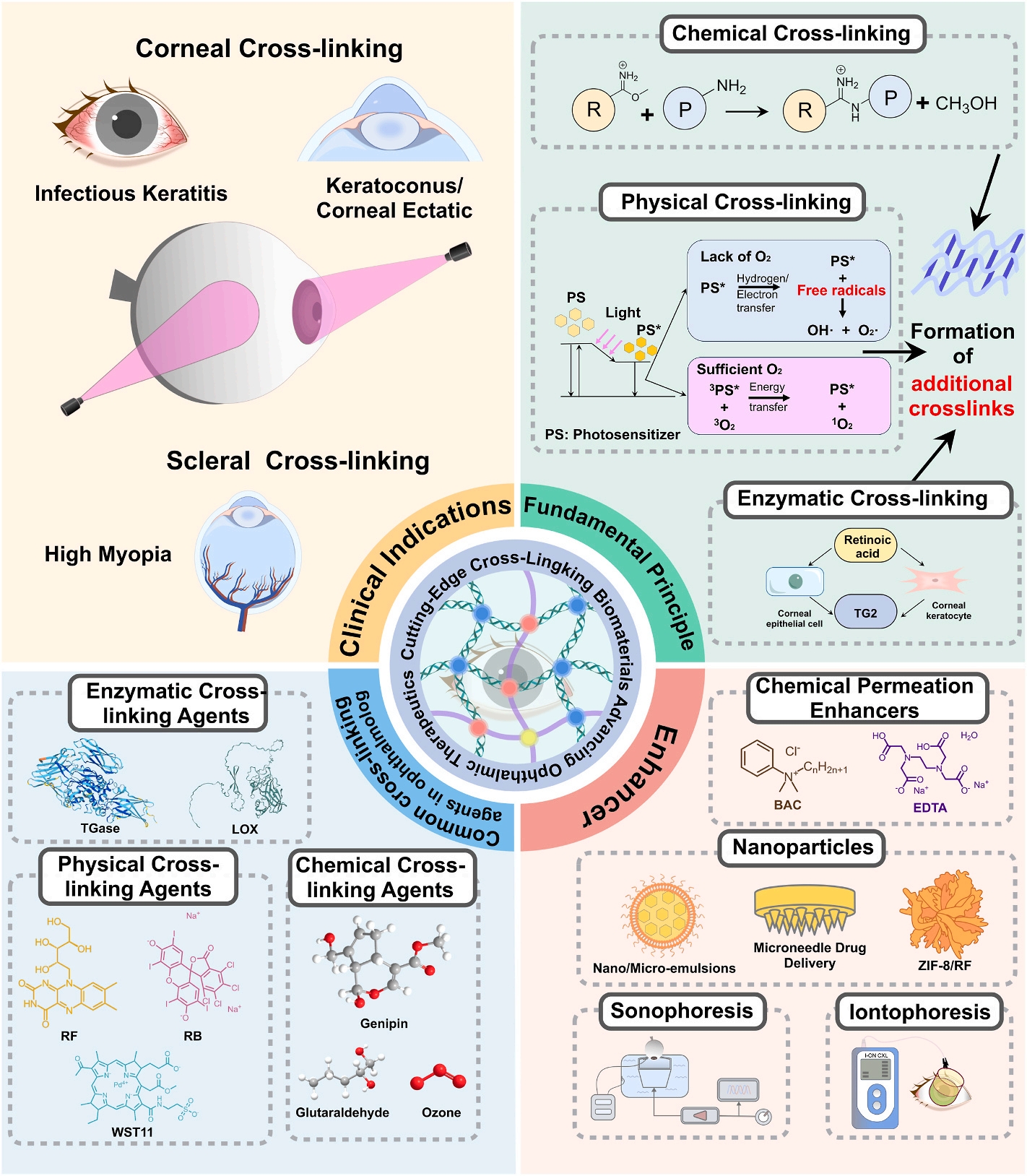
This review systematically summarizes crosslinking biomaterials for ophthalmic therapeutics, focusing on corneal crosslinking and scleral crosslinking. It outlines the mechanisms, representative agents, delivery strategies, and design principles of physical photochemical, chemical, and enzymatic crosslinking, and discusses advances and challenges in enhancing ocular biomechanical stability, penetration, and spatiotemporal control.
(2) Background:
Corneal crosslinking has been used to enhance corneal biomechanical stability and extended to infectious corneal diseases and post-refractive corneal ectasia. Scleral crosslinking is explored for scleral reinforcement in progressive myopia. Conventional protocols are limited by epithelial and scleral barriers, photosensitizer penetration, oxygen supply, treatment depth, and spatial selectivity, driving the development of functional materials and delivery systems.
(3) Main Content:
The review classifies crosslinking by mechanism. Physical photochemical crosslinking includes riboflavin/UVA, rose bengal/green light, WST-11/near-infrared, verteporfin, graphitic carbon nitride quantum dots, and ruthenium-based visible-light systems. Chemical crosslinking includes genipin, glutaraldehyde, formaldehyde releasers, beta-nitroalcohols, carbodiimide/NHS/chondroitin sulfate, and ozone. Enzymatic crosslinking includes transglutaminase and lysyl oxidase. Nanoparticles, liposomes, microneedles, hydrogels, iontophoresis, and ultrasound-assisted delivery are also discussed to improve stromal penetration, controlled release, and reduce invasiveness.
(4) Study Design:
This is a review study. The authors integrate in vitro, ex vivo, animal, and human evidence on corneal and scleral crosslinking according to mechanism and agent class, compare biomechanical reinforcement, enzymatic resistance, penetration depth, oxygen dependence, cell safety, and operational feasibility, and summarize delivery system design principles and evaluation metrics.
(5) Results:
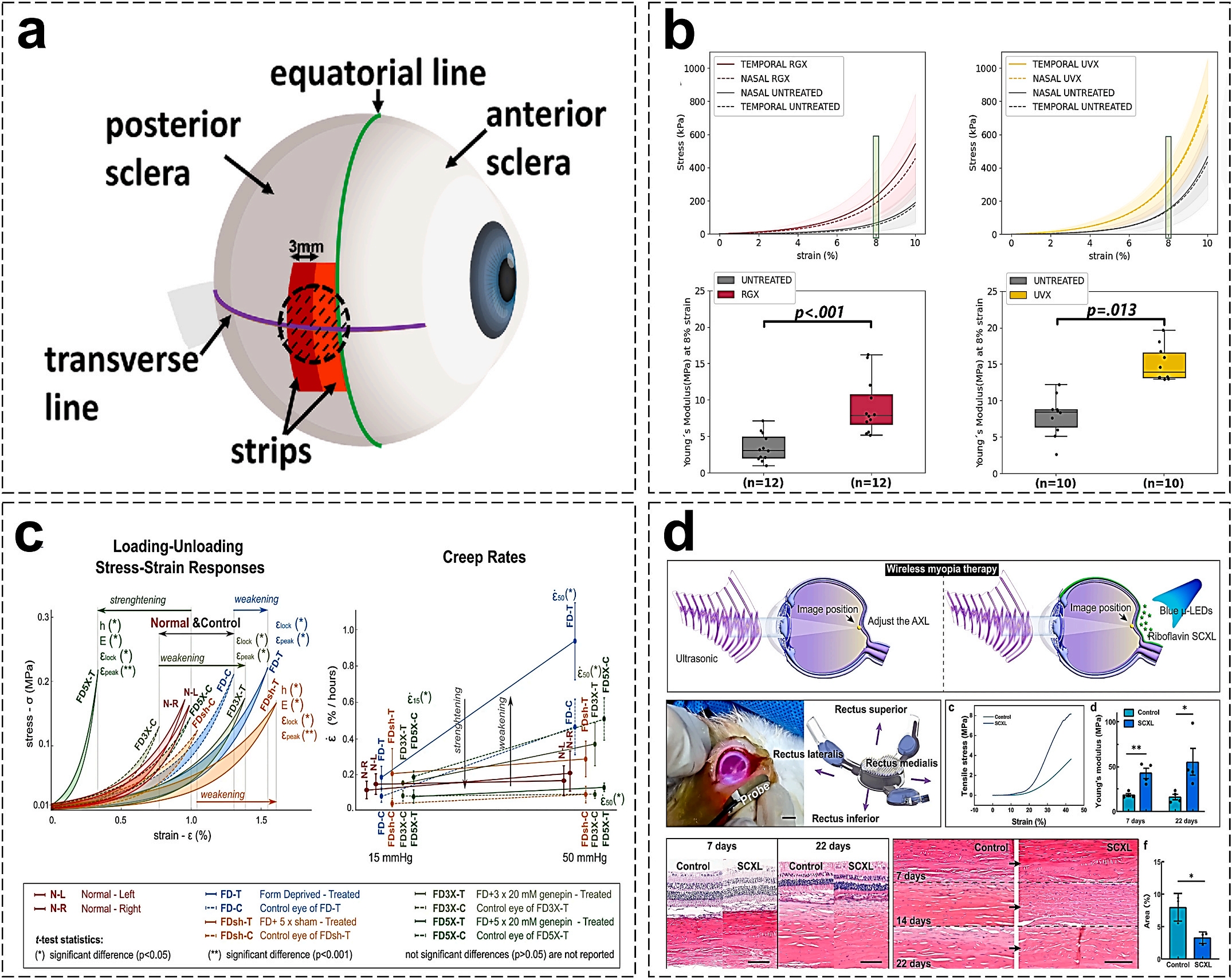
Physical photochemical crosslinking offers spatiotemporal control but is limited by oxygen and penetration. Chemical crosslinking is light-independent; genipin is relatively mild, glutaraldehyde toxicity is limiting, and beta-nitroalcohols and formaldehyde releasers show non-light-dependent potential. Enzymatic crosslinking is biomimetic and biocompatible but requires validation of controllability and long-term stability. Nanocarriers, microneedles, and hydrogels improve photosensitizer loading, penetration, and retention; oxygen supply and pulsed illumination alleviate hypoxia. Scleral crosslinking can increase scleral stiffness but requires attention to intraocular pressure, retina, and optic nerve head safety.
(6) Future Directions:
Future work should standardize crosslinking evaluation, address long-term biocompatibility, material degradation and metabolism, personalized parameters, and spatiotemporal controllability. Theranostic monitoring, portable light sources, multimodal synergy, and artificial intelligence-based dose prediction may shift crosslinking from uniform reinforcement toward pathology-tailored biomechanical modulation.

We provide full-process services for various material designs (including highly innovative scheme design, preparation, characterization, in vitro and in vivo validation (cell/animal experiments), etc.): a postdoctoral team (with multiple high-impact publications in Zone 1 journals) can meet all kinds of tricky and challenging requirements, including hydrogels / drug delivery / nanomaterials / polymers / liposomes / microneedle drug delivery, etc. We can assist with project design / NSFC grant applications / publication of high-impact Zone 1 and Zone 2 papers in journals such as AFM, SCI, AM, etc. Welcome to consult 👇️
17768014569 (Senior Engineer Gao)
17761925168 (Engineer Zhang)
18013729810 (Engineer Yang)
18915694570