

One Orthopedic Idea a Day | Piezoelectric Interfaces Harmonize Bone Infection Repair
(1) Research background
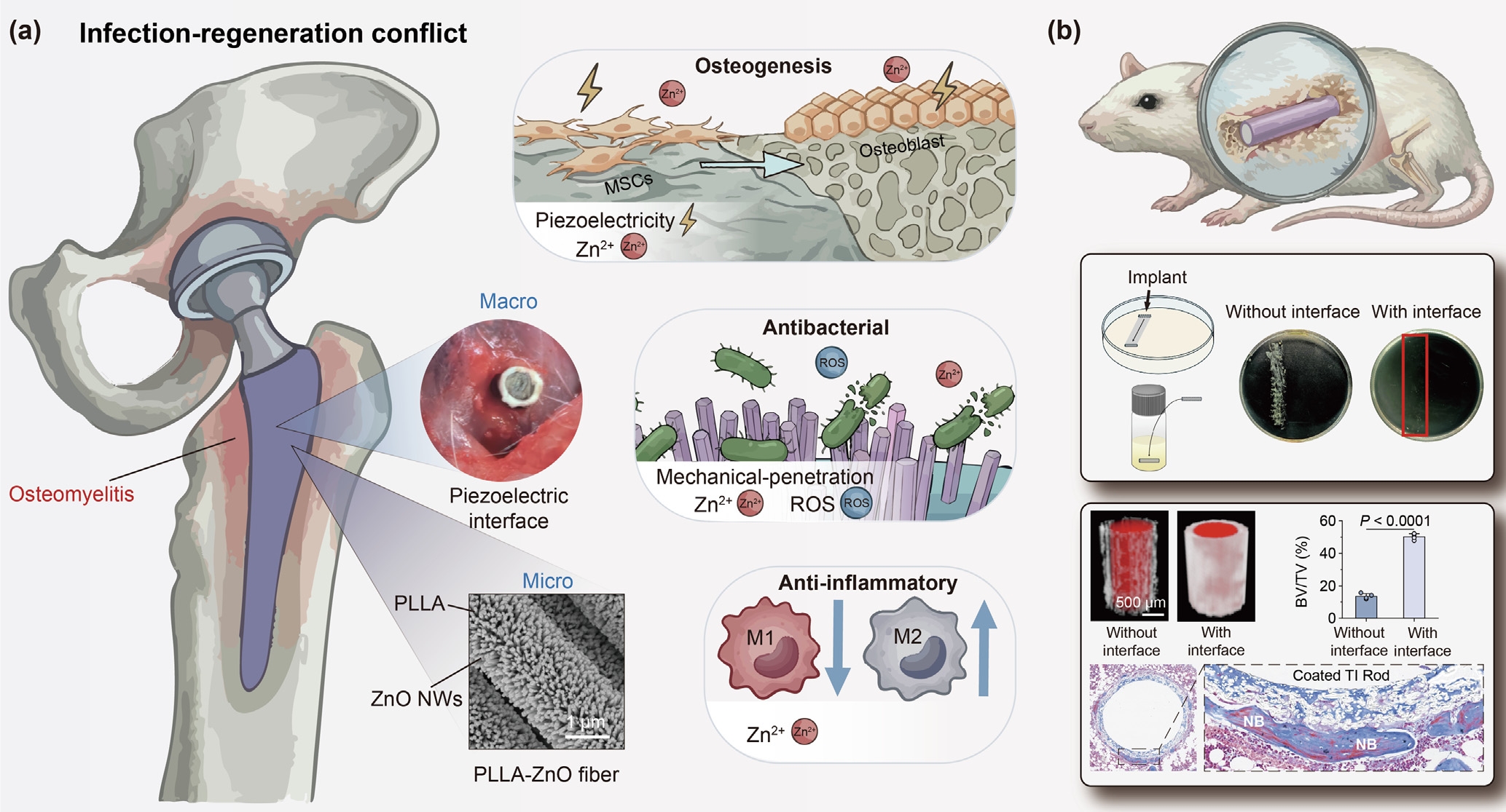
Implant-associated bone infections are often accompanied by persistent infection, inflammatory dysregulation, and impaired bone regeneration, while conventional implants lack intrinsic antibacterial and osteoinductive capabilities. Strategies targeting only antibacterial activity or osteogenesis alone are insufficient to address the pathological coupling between infection and regeneration. Piezoelectric materials can convert physiological mechanical stimuli into electrical signals, mimicking the bone electrical microenvironment and modulating bone immunity. PLLA is degradable but has weak piezoelectricity; ZnO has piezoelectric, antibacterial, and immunomodulatory potential, but nanoparticle embedding often limits ion release and interfacial activity. Therefore, surface architectures that simultaneously improve electromechanical coupling and ion accessibility are needed.
(2) Main content
The authors grew oriented ZnO nanowire arrays in situ on electrospun PLLA fibers and immobilized them on titanium substrates via a polydopamine interlayer. This hierarchical interface enhances piezoelectric output, exposes nanowire morphology, and triggers Zn²⁺ release under infection-related acidic conditions. Antibacterial mechanisms involve mechanical penetration by nanowires, oxidative stress, and Zn²⁺ interference; osteogenesis and immunomodulation are associated with piezoelectric electrical stimulation and ionic signals. Thus, temporally coordinated early antibacterial and anti-inflammatory effects and later osteogenesis and osseointegration are achieved.
(3) Research design
PLLA, PLLA/ZnO nanoparticle control, and PLLA-ZnO nanowire interfaces were prepared; ZnO content was screened; and morphology, structure, hydrophilicity, mechanics, coating adhesion, degradation, and ion release were characterized. In vitro, cytocompatibility and blood compatibility, MSC osteogenesis, macrophage polarization, and antibacterial activity against Staphylococcus aureus and Escherichia coli, biofilm formation, ROS, and membrane integrity were evaluated. In vivo, a rat femoral implant-associated bone infection model was established, and Ti, Ti/PLLA, Ti/PLLA/ZnO, and Ti/PLLA-ZnO were compared for infection, inflammation, and bone regeneration at early and late stages.

(4) Results
The PLLA-ZnO interface exhibited vertically oriented ZnO nanowires, enhanced piezoelectric output, improved hydrophilicity and modulus, PDA-enhanced coating adhesion, and more pronounced Zn²⁺ release under acidic conditions. In vitro biocompatibility was good; it promoted MSC osteogenic mineralization and osteogenic marker expression and promoted macrophage polarization toward a pro-healing phenotype. It showed antibacterial effects against both Gram-positive and Gram-negative bacteria, disrupted bacterial membranes, increased ROS, and inhibited biofilms. In vivo, early bacterial colonization decreased, neutrophil infiltration and pro-inflammatory factors decreased, and anti-inflammatory factors and early osteogenic markers increased; at later stages, bone regeneration and osseointegration improved, inflammation was controlled, and no obvious abnormalities were observed in major organs.
(5) Perspectives
This work suggests that the integration of multiple cues—nanotopography, piezoelectric stimulation, and ion release—can dynamically adapt to the infectious microenvironment and coordinate immunity and osteogenesis. Future studies may further elucidate the specific signaling pathways mediating piezoelectricity-induced osteogenesis, the spatiotemporal dose of Zn²⁺ and nanowire geometric parameters, and evaluate long-term degradation, immune memory, and generalizability across different bacterial species and bone defect models. It provides inspiration for designing next-generation bone implant interfaces, but rigorous mechanistic and long-term safety validation are still required.

We provide full-process services for various material designs (including highly innovative scheme design, preparation, characterization, in vitro and in vivo validation (cell/animal experiments), etc.): a postdoctoral team (with multiple high-impact publications in Zone 1 journals) can meet all kinds of tricky and challenging requirements, including hydrogels / drug delivery / nanomaterials / polymers / liposomes / microneedle drug delivery, etc. We can assist with project design / NSFC grant applications / publication of high-impact Zone 1 and Zone 2 papers in journals such as AFM, SCI, AM, etc. Welcome to consult 👇️
17768014569 (Senior Engineer Gao)
17761925168 (Engineer Zhang)
18013729810 (Engineer Yang)
18915694570
Previous: Custom Nanomaterial Se
Next: Nanomaterial Customiza