

Custom Nanomaterial Service: Ginseng Polysaccharide Composite Microsphere Hydrogel for Wound Repair in *Advanced Healthcare Materials*
 (1) Journal Source: Advanced Healthcare Materials
(2) Title: A Multifunctional Ginseng Polysaccharide Hydrogel Loaded With Rg3 Microspheres
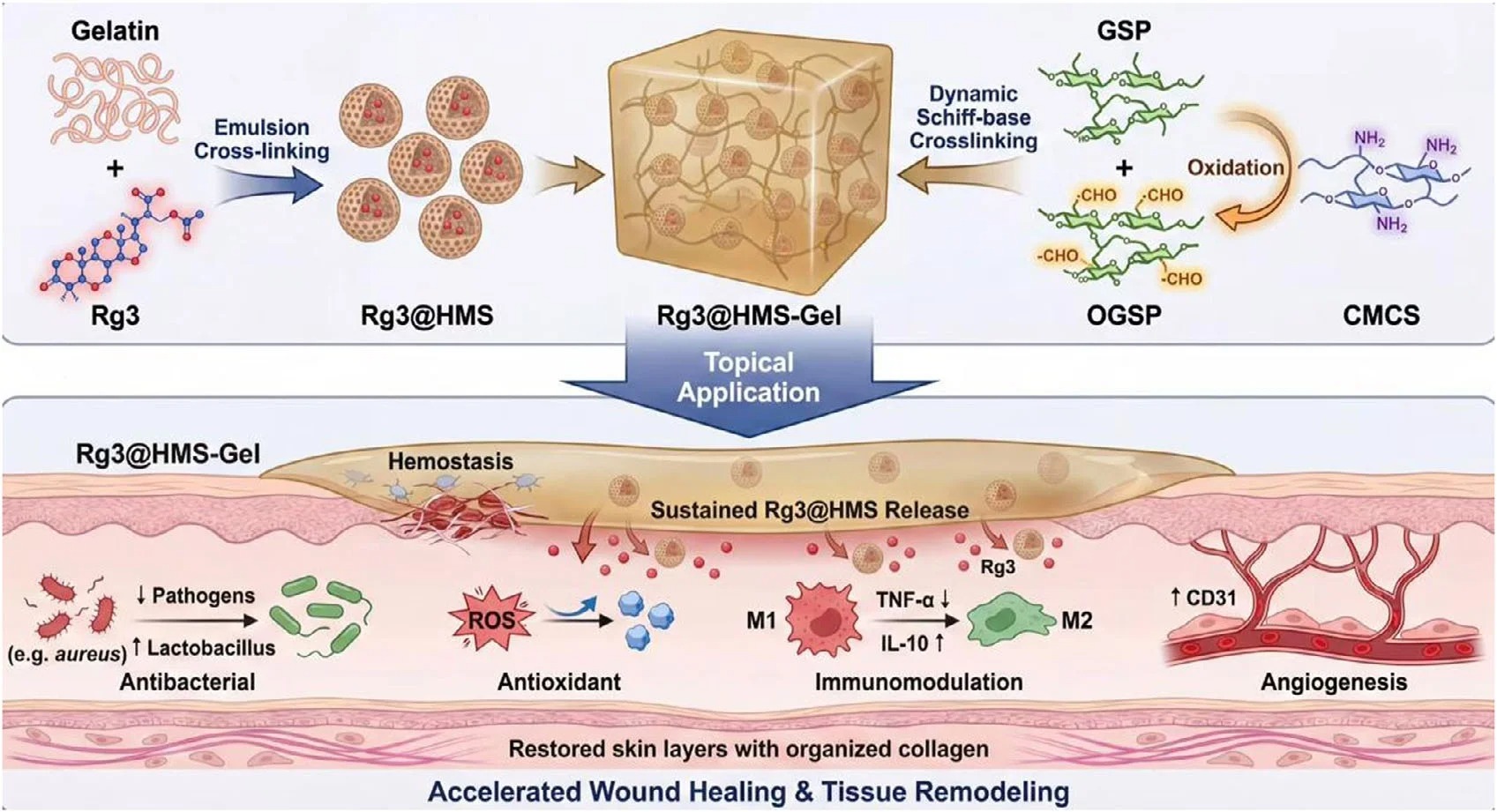
(3) Research Highlights: In this work, gelatin microspheres loaded with ginsenoside Rg3 were incorporated into an oxidized ginseng polysaccharide‑carboxymethyl chitosan dynamic Schiff base crosslinking network to fabricate a composite hydrogel. The sequential synergistic effect of ginseng polysaccharides and ginsenoside Rg3 was adopted to achieve sustained drug release and optimized physicochemical properties simultaneously. Multiple biological effects of the material including antioxidant activity, repair‑promoting performance and microbiota regulation were investigated at the cellular and animal levels.
(4) Innovations: An injectable composite hydrogel was fabricated via dynamic Schiff base crosslinking between oxidized ginseng polysaccharides and carboxymethyl chitosan; microsphere carriers were used to address the poor water solubility and rapid clearance of hydrophobic Rg3; the two active components realized sequential synergism at different stages of wound repair; the hydrogel can remodel the skin microbiota of wounds and regulate the wound microenvironment from both host immune and microbial perspectives.
(5) Material Development (1) Materials: oxidized ginseng polysaccharide (OGSP), carboxymethyl chitosan (CMCS); Rg3‑loaded gelatin microspheres prepared by emulsion crosslinking method; the Rg3@HMS‑Gel composite hydrogel was obtained by combining the above two components. (2) Functions: It possesses injectability, moldability, self‑healing capacity and tissue adhesion; it exhibits antioxidant, antibacterial and hemostatic activities; it facilitates the migration and proliferation of keratinocytes, modulates macrophage phenotypes, promotes angiogenesis and collagen deposition, and regulates the microbiota composition at wound sites.
(6) Extended Outlook: The paper hypothesized that short‑chain fatty acid metabolites derived from altered microbiota participate in wound repair. Subsequent studies can perform quantitative detection of short‑chain fatty acids at wound sites, verify relevant receptor pathways, and supplement mechanistic evidence for metabolite‑host interactions.
We provide full-process services for custom material design, including innovative scheme design, fabrication, characterization, and in vitro & in vivo validation (cell and animal studies). Our postdoctoral team with multiple high-impact Q1 publications can tackle your challenging research demands. Our scope covers hydrogels, drug delivery systems, nanomaterials, polymers, liposomes, microneedles and more. We support project design, NSFC proposal writing, and high-quality SCI manuscripts for journals such as AFM, AM and other Q1/Q2 journals. Enquiries are welcome👇
17768014569 (Dr.Gao)
17761925168 (Dr. Zhang)
18013729810 (Dr. Yang)
18915694570
Previous: Daily Inflammation Ide
Next: Nanomaterial Customiza