

Spatially Gradual Penetration! Dual-Gas-Driven Nanomotors for Biofilm Eradication
Biofilms and deep inflamed tissues in chronically infected wounds form multi-layered physical barriers that hinder effective drug delivery. This paper proposes a spatially progressive penetration strategy and designs a self-propelled Dex@CQDs@mPDA nanomotor, which aims to sequentially overcome biofilm and deep tissue barriers to achieve stepwise treatment from the surface to deep layers.
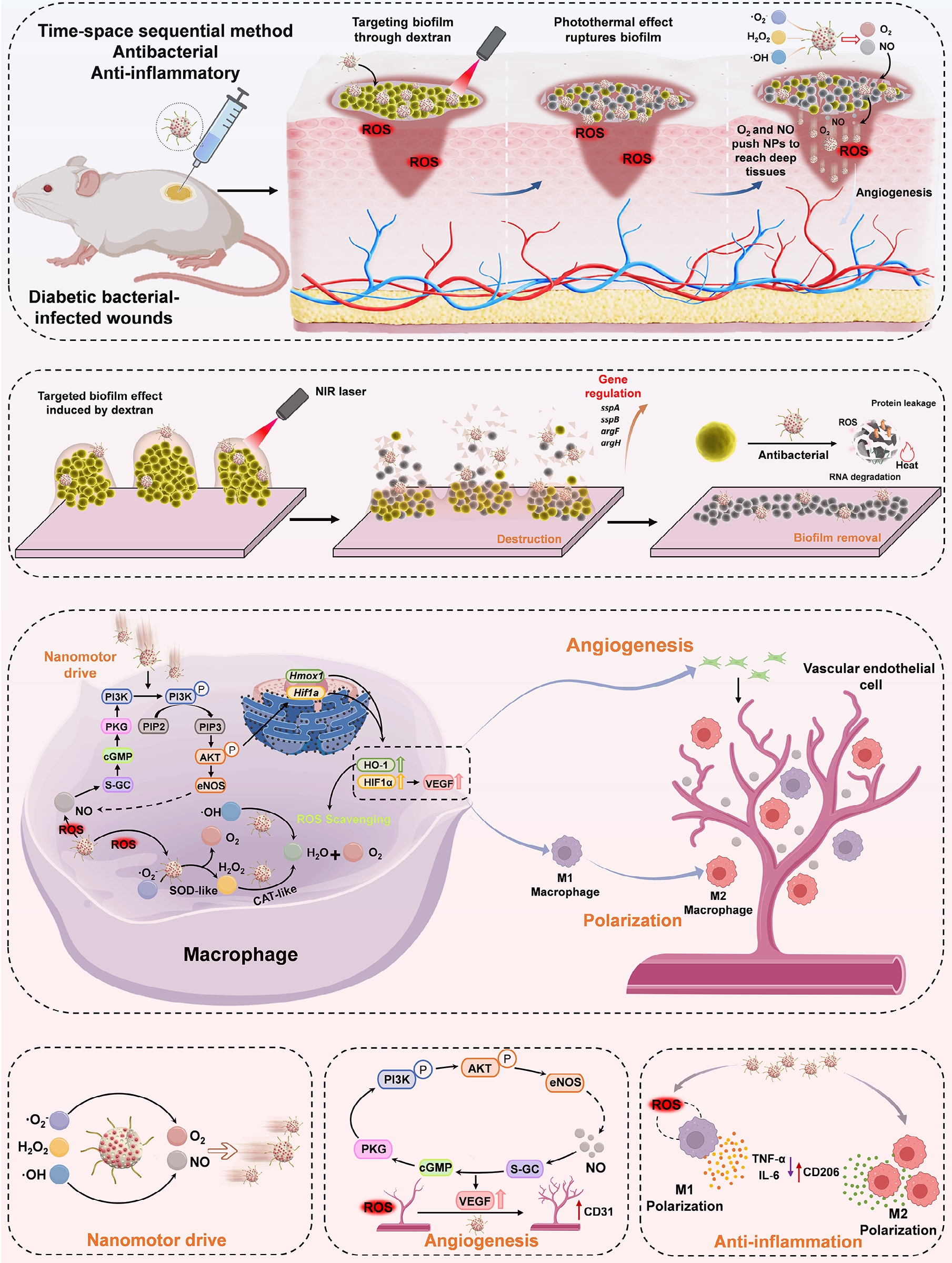
Dual-gas propulsion is adopted to realize active deep penetration. The nanomotor consists of mesoporous polydopamine (mPDA) loaded with carbon quantum dots (CQDs). In the infected microenvironment, mPDA catalyzes hydrogen peroxide to generate oxygen, while CQDs release nitric oxide in response to oxidative stress. The synergistic effect of the two gases provides strong propulsion to drive the nanomotor to actively penetrate deep inflamed tissues. Meanwhile, it effectively eliminates excessive local reactive oxygen species and ameliorates the hypoxic microenvironment.
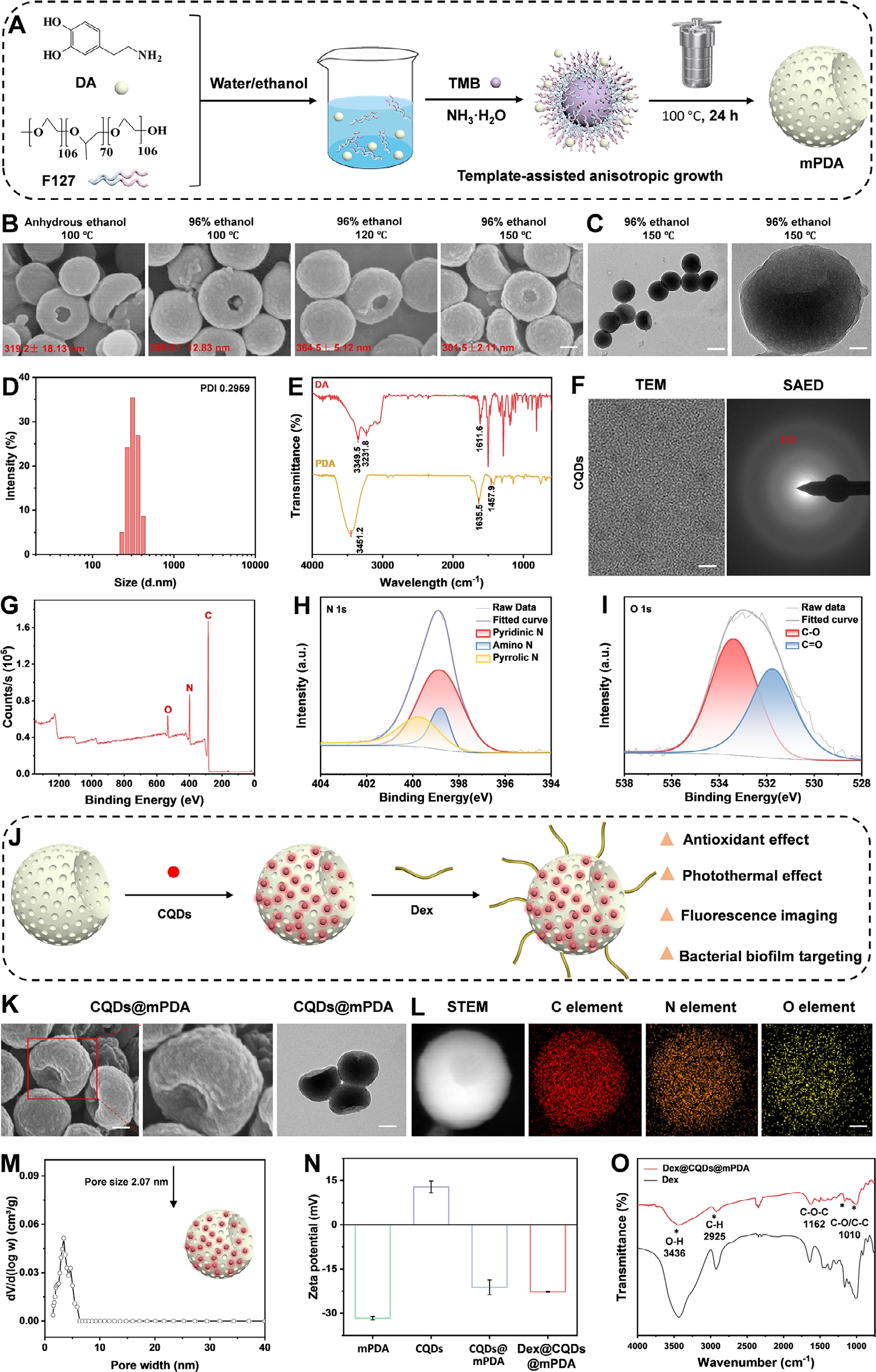
Dextran modification is utilized for precise biofilm targeting and photothermal disruption. The surface of the nanomotor is modified with dextran (Dex), which can specifically recognize the biofilm matrix and preferentially accumulate at infection sites. Under near-infrared irradiation, the photothermal effect of mPDA generates localized high temperature, which efficiently disrupts the dense extracellular polymeric substance matrix, collapses the physical barrier of biofilms, exposes internal bacteria, and achieves high-efficiency photothermal sterilization.
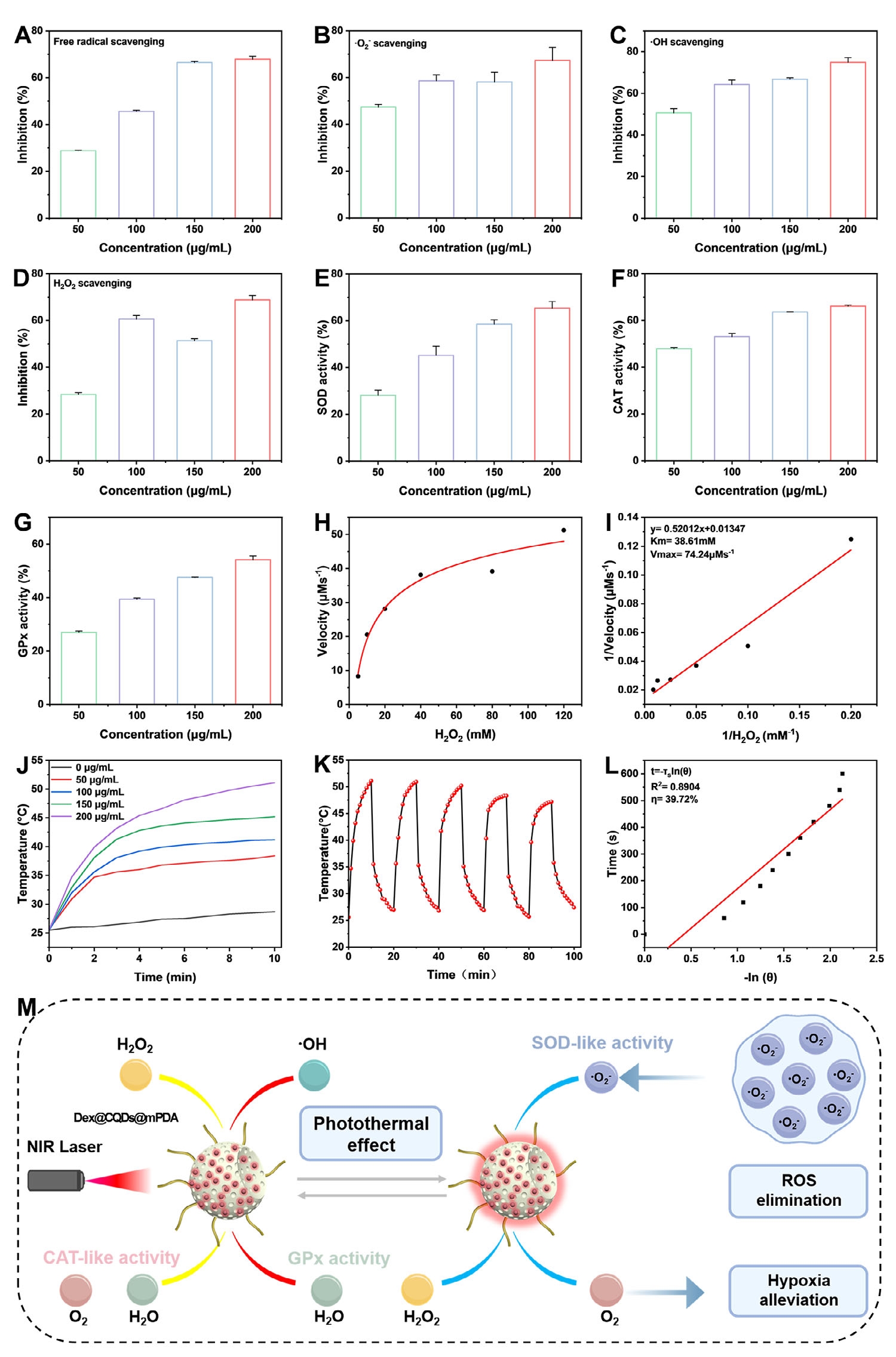
Multifunctional cascade reactions are leveraged for microenvironment remodeling and tissue regeneration. After crossing the barriers, the nanomotor exhibits broad-spectrum antioxidant and enzyme-mimicking activities, which markedly reduce the level of reactive oxygen species at inflammatory sites. Meanwhile, it can inhibit inflammatory signaling pathways, induce the polarization of macrophages from the pro-inflammatory M1 phenotype to the anti-inflammatory M2 phenotype, alleviate local inflammatory infiltration, and promote angiogenesis and collagen deposition, thereby accelerating tissue repair and remodeling of infected wounds.
We provide a full range of materials design services covering highly innovative scheme design, preparation, characterization, in vitro and in vivo validation (cell/animal experiments), etc. Our postdoctoral team, with numerous high-impact Q1 publications, can tackle your most challenging and complex research needs. Our areas include hydrogels, drug delivery, nanomaterials, polymers, liposomes, microneedle drug delivery and more. We support project design, National Natural Science Foundation application, and publication of high-impact Q1/Q2 papers such as AFM, SCI, AM. Feel free to reach out👇️
17768014569 (Senior Engineer)
17761925168 (Engineer Zhang)
18013729810 (Engineer Yang)
Dual-gas propulsion is adopted to realize active deep penetration. The nanomotor consists of mesoporous polydopamine (mPDA) loaded with carbon quantum dots (CQDs). In the infected microenvironment, mPDA catalyzes hydrogen peroxide to generate oxygen, while CQDs release nitric oxide in response to oxidative stress. The synergistic effect of the two gases provides strong propulsion to drive the nanomotor to actively penetrate deep inflamed tissues. Meanwhile, it effectively eliminates excessive local reactive oxygen species and ameliorates the hypoxic microenvironment.
Dextran modification is utilized for precise biofilm targeting and photothermal disruption. The surface of the nanomotor is modified with dextran (Dex), which can specifically recognize the biofilm matrix and preferentially accumulate at infection sites. Under near-infrared irradiation, the photothermal effect of mPDA generates localized high temperature, which efficiently disrupts the dense extracellular polymeric substance matrix, collapses the physical barrier of biofilms, exposes internal bacteria, and achieves high-efficiency photothermal sterilization.
Multifunctional cascade reactions are leveraged for microenvironment remodeling and tissue regeneration. After crossing the barriers, the nanomotor exhibits broad-spectrum antioxidant and enzyme-mimicking activities, which markedly reduce the level of reactive oxygen species at inflammatory sites. Meanwhile, it can inhibit inflammatory signaling pathways, induce the polarization of macrophages from the pro-inflammatory M1 phenotype to the anti-inflammatory M2 phenotype, alleviate local inflammatory infiltration, and promote angiogenesis and collagen deposition, thereby accelerating tissue repair and remodeling of infected wounds.
We provide a full range of materials design services covering highly innovative scheme design, preparation, characterization, in vitro and in vivo validation (cell/animal experiments), etc. Our postdoctoral team, with numerous high-impact Q1 publications, can tackle your most challenging and complex research needs. Our areas include hydrogels, drug delivery, nanomaterials, polymers, liposomes, microneedle drug delivery and more. We support project design, National Natural Science Foundation application, and publication of high-impact Q1/Q2 papers such as AFM, SCI, AM. Feel free to reach out👇️
17768014569 (Senior Engineer)
17761925168 (Engineer Zhang)
18013729810 (Engineer Yang)
18915694570
Previous: BK Oncolytic virus pla
Next: Nano-material Customiz