
SCLC Drug Resistance|Multi‑omics Mining of Potential Therapeutic Targets
🔍 Mechanism of this paper
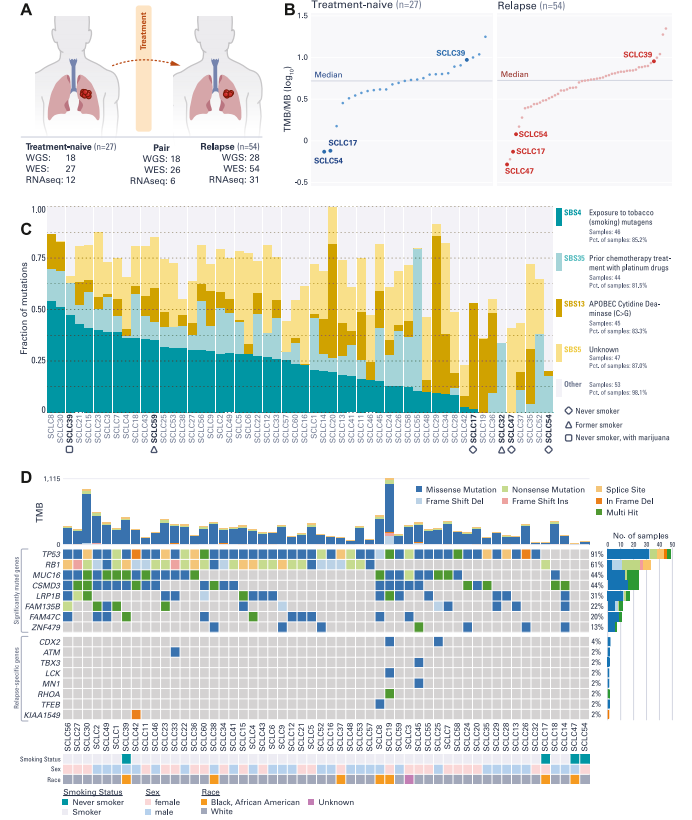
Platinum‑based chemotherapy for SCLC frequently results in relapse and drug resistance. Using patient‑matched treatment‑naive and relapsed clinical samples together with multi‑omics of WGS/WES/RNA‑seq, the study found that relapse is not driven by increased TMB but by reprogramming of the genome, splicing and immune pathways. Relapsed tumors are enriched with platinum‑ and APOBEC‑related mutational signatures and exhibit MYC‑family amplification. Immune escape is mediated by CD24, HLA‑E and M2‑type macrophages. Loss of intron‑retention events occurs in relapsed samples; PRMT5 drives aberrant splicing and activates the WNT/MYC pathways, contributing to drug resistance.
💡 Innovations & Breakthroughs
▪️ A scarce cohort of patient‑matched human SCLC samples filling the multi‑omics gap for relapsed SCLC
▪️ Relapse is dominated by qualitative shifts in mutational profiles and complex chromosomal rearrangements
▪️ Splicing reprogramming and multi‑pathway immune escape are identified as key drivers of drug resistance
🧠 Key Insights
▫️ Drug resistance arises not only from novel mutations; transcriptional and splicing reprogramming also play critical roles ▫️ High neoantigen load does not guarantee effective anti‑tumor immunity; PRMT5, WNT and CD24 represent potential therapeutic targets
📌 Key Information
▪️ Samples: 54 relapsed + 27 treatment‑naive clinical specimens, including 26 patient‑matched pairs
▪️ Core pathways: MYC amplification, WNT signaling, PRMT5‑mediated splicing, CD24‑Siglec10 immune‑escape axis
▪️ Methods: multi‑omics sequencing, neoantigen prediction, alternative‑splicing analysis, immune deconvolution
✨ Nanomaterial‑oriented Research
Idea To counter multi‑pathway‑mediated drug resistance, construct nano co‑delivery systems loaded with splicing inhibitors plus immune‑modulatory agents to improve tumor accumulation. Research workflow: identify targets via clinical multi‑omics → functional validation → nano‑delivery‑based intervention against drug resistance. Well‑suited for cross‑disciplinary National Natural Science Foundation projects.
We provide full‑cycle services covering diverse material design (high‑novelty scheme design, preparation, characterization, in‑vitro & in‑vivo validation including cell and animal experiments). Our postdoctoral team with multiple high‑impact Q1 publications can tackle sophisticated and challenging research demands. Services cover hydrogels, drug delivery, nanomaterials, polymers, liposomes, microneedle drug‑delivery systems and more. Support includes project design, National Natural Science Foundation proposal writing, and publication of Q1/Q2 SCI papers such as AFM, AM. Feel free to contact us👇
Mr. Gao : 17768014569
Mr. Zhang : 17761925168
Mr. Yang : 18013729810
#Nanomaterials #CustomNanomaterial #BKNano #Tumor #Nanoparticles #Nanomedicine #LifeScience #CustomNanomaterialSynthesis #ResearchService #NanomaterialSynthesis #SCIResearch #ScientificResearchMaterials
18915694570
Previous: BK Oncolytic virus pla
Next: the end...